Thursday, October 12, 2017

Inside Dental Technology Magazine features Mountain Dental Lab


Mountain Dental Lab continuously researches, tests and perfects materials and techniques that quell your thirst for an ideal dental restoration, as shown in Inside Dental Technology:


"October 2017 Volume 8, Issue 10

Premium Products Help Laboratory Owner reach Ambitious aspirations

One company provides equipment, materials, and now a digital denture solution
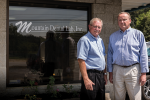
George Zoller, CDT, had a clear vision for Mountain Dental Lab when he and Danny Ingle joined forces as owners approximately 13 years ago. Zoller had previously helped build another successful laboratory before working as a consultant for a few years, and he brought that breadth of experience to the new venture, which he and Ingle were able to mold to their liking.
“We were not interested in owning a commercial laboratory and having impersonal relationships with clients,” Zoller says. “We wanted to be recognized as a relationship-oriented laboratory. We wanted to really feel we were a part of the dental practice and that we brought value to the dental team. We wanted to be a resource in terms of education, materials, service, etc.”
The venture has been a success. Mountain Dental Lab is now a 13-person operation in a 5,000-square-foot facility, serving mostly regional clients but also some nationwide.
“We have found that clients who are of that same collaborative mindset gravitate toward us,” says Zoller, who specializes in implants and education. “The client that comes here is interested in what we do, how we do it, and how it complements the practice.”
Mountain Dental Lab’s slogan is, “We love being part of your practice.” The laboratory’s three guiding principles are being a part of the dental team, providing only the finest materials, and good, old-fashioned customer service.
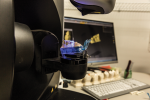
Dentsply Sirona has helped the laboratory fulfill those promises. Zoller began using the company’s CAD/CAM equipment more than a decade ago and acquired an inLab MC X5 mill and an inEos X5 scanner approximately 2 years ago.
More recently, Zoller began using Dentsply Sirona’s Celtra Press zirconia-reinforced lithium silicate (ZLS) material. The chemical properties of this high-strength glass-ceramic create a unique microstructure that provides esthetics, strength, and efficiency.
The specially developed Celtra Press investment minimizes the formation of a hard reaction layer between the investment and the press restoration. Along with a lower pressing temperature than lithium disilicate, this eliminates the need to use cleaning fluid containing hydrofluoric acid.
“We fabricate a high volume of lithium disilicate restorations, and the first thing we noticed when we began using Celtra Press was the reaction layer, which saves an incredible amount of time,” Zoller says. “It is not necessary to put the restoration in an acid bath, worry about the fit, or worry about the margins chipping. Right away, that was a significant benefit for our workflow efficiency.”
Celtra Press also displays a high level of translucency that is unusual for materials with flexural strengths higher than 500 MPa.
“Empirical evidence in the laboratory confirmed that Celtra Press did what they said it was going to do,” Zoller says. “We were particularly impressed when we saw the vitality and the effect of this material in the mouth.”
To build that level of confidence among dentists, Zoller fabricated two crowns for each case for some clients—one from the prescribed material and one from Celtra Press.
“When dentists put Celtra Press in the mouth, they usually selected that option,” he says. “We now use it for almost every restoration where it’s appropriate to the shade.”
As Mountain Dental Lab continues to strive to provide its customers with the best products and service, Zoller has been investigating digital dentures. He has paid particularly close attention over the past few years to AvaDent Digital Dental Solutions, which has partnered with Dentsply Sirona to create Dentsply Sirona Digital Dentures, a digital solution that provides superior fitting dentures made with Lucitone 199® Denture Base Discs and Portrait® IPN® Denture Teeth.
“Clients are starting to call us about digital dentures, so we hope to offer that service soon,” he says. “I am really anxious to continue learning about the partnership between AvaDent and Dentsply Sirona and the developments that arise from it.”
The prospect of working on digital dentures with the same company that provides CAD/CAM equipment, materials such as Celtra Press, and more is enticing to Zoller. Dentsply Sirona Digital Dentures offer wide-ranging benefits; the denture materials are optimized to work with Dentsply Sirona scanning and milling machines but can be used with a wide range of equipment from other manufacturers. Whether laboratories choose to mill in-house or scan and outsource the entire process, Dentsply Sirona Digital Dentures offer flexible solutions and provide superior results for either Portrait bonded dentures or monolithic ones.
“It is certainly an advantage to have all systems running in the same gear, and to have the same company providing not only the materials but also the equipment for every need,” he says. “They can handle everything. When you are working through cases, it is nice to have that range of abilities within the same family. In the future, as the merger matures, it will be fantastic for consistency across the board.”
For more information, contact:
Dentsply Sirona Prosthetics
dentsplysirona.com
800-243-1942"

Source: Inside Dental Technology Magazine: October 2017 Issue

Wednesday, August 2, 2017

Celtra Press Ceramic Dental Crown & Bridge Material

A New Generation of Dental Ceramics

The year was 1988 when dental laboratories first heard about an "Aesthetic Revolution". Up until that time, we had limited materials to work with, and doing cosmetic cases was challenging - to say the least. Porcelain was heavy-grained and metal framework had to be masked, making it difficult to refract light and produce natural-looking dental restorations. So, dental technicians settled for something that resembled glow-in-the-dark Chiclets. We all wished for something that was strong and translucent. There were many products that tried to hit this mark, but somehow, all missed due to their compromises in either strength or beauty.

Fast-forward to today. The science of dental materials has brought some tantalizing options to the table. We have Full Contour Zirconia (Zirconium Oxide), which definitely gives strength enough to eliminate metal frameworks, but doesn't always deliver aesthetically. Dental technicians also have Lithium Di-Silicate that has been the aesthetic standard for years, but it also has some limitations when it comes to multiple splinted units. Now, a new player in dental ceramics has taken the field! Celtra Press (Zirconia-Reinforced Lithium Silicate) from Dentsply Sirona has achieved all of the expectations dental labs, dentists, and patients, have been hoping for. It combines strength and beauty into one product that is versatile and translucent. We have been using Celtra in our lab for the past year, and have noticed several positive improvements that we believe have benefits for the clinician. 

  1. Strength of 500 MPA: Fracture resistance at 500 MPA opens up possibilities for not only anterior, but posterior, bridgework, and implant restorations. All this without the dense, glow-in-the-dark look of other high-strength ceramics. 
  2. High-Translucent Index: This material refracts light in a way that is similar to enamel rods found in natural teeth..The main reason for this is that the crystal particle size is smaller, so it not only looks more lively, but it blends well with the surrounding dentition, giving it a chameleon effect. This is especially beneficial for restorations that have high-translucency and a dark shade. 
  3. Magical Margins: Celtra has a better resistance to chipping in thinner areas such as margins around implants, which allows us to use this material in areas where we once had to choose a less-aesthetic material in the past. 
In summary, we are excited about this new tool for the toolkit of aesthetic options, and how it can bring a "wow" factor to your dental practice. If you would like more information on Celtra, we have printed guides available for your office, or we will come to your office for a lunch and learn presentation at your convenience. Thanks for your time.

George Zoller, CDT


Wednesday, June 14, 2017

Dental Implants: In an expedient era, what you don't know can delay you

Dental Implants: 
In an Expedient Era, What You Don't Know Can Delay You

Today, dental implants are a standard part of a dental practice. They are reliable, predictable, and when designed properly, the restoration seats easily. Dentists have the option to use a stock abutment, or a custom abutment designed specifically for the patient in question. Custom abutments designed via CAD/CAM (Computer-aided Design/Computer-aided Manufacturing) further enhance the process by providing a custom solution for each case with the final restoration in mind, giving proper tissue emergence and strength for the desired material choice. Before any of that is decided upon, however, the impression coping and implant replica must be considered.

The challenge for dental labs doing implant restorations is lack of information. There are approximately 15 recognized implant companies in the U.S., and almost 200 companies worldwide making some type of dental implant. Many of these companies have their own connection type and parts, and many of these parts look alike. It is understandable that there would be some confusion when attempting to locate the correct driver or screw, or trying to determine which implant system it is just by looking at an impression post. Ordering the wrong part, or trying to find out which implant system it is can cost time and money for both parties.

Here are some practical steps that will insure success with every implant case:
  1. Always communicate the type of implant system in its entirety. Many implant manufacturers have sub-categories. For example, Nobel Biocare Active vs. Nobel Biocare Replace. The surgeon who placed the implant will have this information in writing, which can be copied and sent with the prescription for the implant case to the lab.
  2. Verify the platform size. Implant systems usually have three main measurements; the length, the implant size, and the platform size. The lab needs the platform size more than all other measurements. For example, an implant might be listed as a 3.8, when in fact the platform size is a 3.0.
  3. When ordering an impression post, also order the coinciding implant replica/analog at the same time. This saves the dental practice money, and it saves the lab time. 
  4. For implant cases covering 4 or more units, include a study model or a diagnostic wax-up to ensure the lab achieves proper restoration placement.
  5. Allow a minimum of 3 weeks for the lab to return the finished case. Implant cases take more time to process, as more steps are required.
These are suggestions for making implant restorations a reliable part of the dental practice. Parts can be challenging, given the number of systems available. Mountain Dental Lab, Inc. has short implant lunch and learns that can help you and your staff with identifying and ordering the proper parts. We would be happy to schedule one of these for you - just give us a call at 828-665-2257 or email me at MountainDentalLab@gmail.com. Our goal is to support you in what you do, because

"We Love Being Part of Your Practice"

Thank you for your time.

George Zoller, CDT

Wednesday, February 15, 2017

Selecting a Crown Shade

DENTAL EDUCATION

Selecting a Shade


Top: Ivoclar Vivadent Shade Guide
Bottom: Ivoclar Vivadent Prep Shade Guide

Selecting the appropriate shade for a patient's crown or bridge can sometimes by trying. There are many factors that contribute to the way a patient's teeth look, which can result in varied outcomes. To assist with obtaining an objective shade, take into consideration the following factors:
  • Light
    • Location
    • Color & Temperature
    • Source
  • Surrounding Objects
    • Operatory Walls​
    • Clothing of Patient
  • Shade-Taker
    • ​2nd Opinion from Staff Member
  • Digital Camera
    • Shade Tabs​
    • Clarity
  • Prep Shade
    • Shade Tabs
Ensure the source of light is directed relative to the patient as they would normally be seen (i.e. have the patient sit up in the chair, and use passive light from above). When possible, use natural light, or use color-corrected bulbs.

If a patient is wearing a red shirt and pink lipstick in a room with yellow walls, the light will reflect off of these objects and onto the teeth, presenting a skewed shade.

Everyone's eyes interpret color differently. It never hurts to ask a second opinion.

When taking a shade photo to send to your dental lab, include the shade tabs in the photo, holding them up as they would read on adjacent teeth (match Gingival to Gingival, etc.). 
​
If an all-porcelain crown is requested, providing a stump/prep shade is extremely helpful to the dental lab technician in determining the material shade. Most all-porcelain materials are translucent, allowing light to shine through, reflect off the prepped tooth, and transmit it's shade back through the porcelain material. 

Referenced from: Charles J. Goodacre, DDS, MSD; Paul A. Sagel, BSChE "Dental Esthetics in Practice:
Part 3 - Understanding Color & Shade Selection" Crest® Oral-B®
at dentalcare.com Continuing Education Course, Revised October 27, 2011

Thursday, April 3, 2014

The Missing Link

This week we welcomed Dr. Gene Withrow as our guest blogger. Dr. Withrow has had over 40 years experience as both a general dentist and a board certified prosthodontist. He has held positions as a clinician, researcher, and educator. He also has been a private practitioner in South Carolina, North Carolina and Alabama. Dr. Withrow serves as a technical consultant to Mountain Dental Lab, to share his knowledge and experience to MDL and the clinicians we serve, to provide the best quality of dentistry possible. We would appreciate your feedback on his helpful hints and your areas of interest for future topics.

The Missing Link

In my years in clinical practice I had the opportunity to visit many labs, both commercial and private. I am always amazed how little attention is given to study models…our missing link! The study model for me is the key to success. I would never start a large fixed or removable case with it. Think of the information a study model provides by accurately mounted casts. Size and shape are obvious. Casts can be duplicated and diagnostic wax-ups can be shown to the patient to discuss restorative possibilities. This communication is invaluable to make sure the doctor and patient are on the same page regarding final expectations.

Once all parties agree on the overall design of the case, temporaries can be made from the wax ups. This allows the patient to see the anticipated result in the mouth. The doctor will be able to analyze esthetics and function, making the delivery of the final prosthesis without problem. Duplicating the wax up in hard stone and a vacuum matrix can provide you a temporary shell and/or preparation guide. When you have all this information from the beginning of a case you will eliminate many variables that can go wrong and provide yourself a road map to success!

My technical tip is to have a clean, bubble free study cast. If you use alginate, make sure the impression is poured before any distortion takes place. Make sure you have an accurate bite. Several manufacturers make an alginate replacement that is distortion free, which can also be repoured. If you would like a list of those products, send me an email and I will get back to you. Also, feel free to contact me with any questions.


Dr. Withrow

Tuesday, April 16, 2013

Digital Photography for Shade Selection

Recently I received a photo album from one of our dentists. It was pictures of some of the cases we had completed in the past year and he wanted us to see these cases in the mouth. He and the patients were thrilled with the result. I was impressed with the results as well; mostly with how well the crowns blended in with the natural dentition. You have a hard time telling which tooth was the crown! While I was musing on this I had a thought. We have always enjoyed doing good work , but the real credit goes to the dentist for providing the lab the most important element to a successful case..Information!!

I realized the dentist had made it easy to get a great result by using digital photography to communicate shading. The digital camera puts the tech right in the office with the patient and takes unknown variables out of the equation of the case. Back in the day when all we had was a written shade map, color variations were left up to the interpretation of the person viewing and the person receiving the information. Notes like “a little orange” or “grey on the incisal” were variable. Are there not many levels of orange and grey? Eliminating these variables may seem simple, but it absolutely essential to producing a great restoration. When a ceramist can build a crown looking at a life sized image of the tooth on a computer screen the results are beautiful!

The picture the lab received to communicate shade.

The final result!

I find sometimes people are intimidated by digital photography, assuming it is too complex or expensive. It doesn’t have to be either. Advanced photo equipment can be bulky and expensive, not to mention difficult to operate. There are several point and shoot model cameras with good lenses that achieve what is needed in  communicating information about shade. Along with proper shade tab placement and labeling, excellent  results can be reached. We can help facilitate digital photography for shade selection in your office if you are interested.

I am really happy when we work as a team and produce great crowns for our patients. With the materials we have today and the means of communication available, it is exciting to think of the potential!

Monday, November 5, 2012

Changing Seasons


Fall is upon us. It is the season of change. Everything changes, leaves change, temperatures change, clothing changes and it's good in a way because it reminds us that we have to adapt to changing paradigms. The same is true in dentistry. There was a time when restorations were pretty much porcelain fused to gold, or full cast gold crowns, but change is upon us. If you haven’t noticed gold is hovering around $1700.00 per ounce and the economy...well it is just hovering. Gold as a component of crowns increases the cost of restorations as it goes up. Gold is not the only volatile component either. Palladium, which is frequently alloyed with gold is three times the cost it was in 2009. The challenge then becomes twofold, how to offer a product at the highest quality level and making it cost effective in a weak economy.

This is where we take a look at the new materials that are available and see if they fill a need. Full contour Zirconia for example as a replacement for some gold crowns is a great option. Extremely strong, tooth colored and less than half the cost could help patients afford a restoration. New alloys that are noble but with less cost and less price volatility give great results at a reduced fee. CAD-CAM technology has allowed us to control costs and offer better material choices.

The point is that change is good because it forces us to find alternatives and sometimes in the alternatives, we actually find a better way. Now is the time to discuss materials with your lab and see if you are taking advantage of all that is available today. These combined with our standard restorative products can give a range of great options for every situation.

So enjoy the fall and if you haven’t already done so…break out the sweaters!

Wednesday, September 12, 2012

Welcome to our new blog at Mountain Dental Lab. We are excited to have this opportunity to share some exciting things that are going on in dentistry and have a little fun as well. We hope you will enjoy and participate.

I started in the dental lab field in 1979. We had basically two material choices, Ceramco or full cast crowns. Restorations were not always pretty and you had to work very hard to get a result that was pleasing. Manufacturers were constantly trying to give us a great result by refining their porcelain systems. The major complaints of those days were the grey discoloration at the gingival and the overall dead look of porcelain. Strength of the restoration was an issue as well.

The 1980's brought some interesting products to try, to hopefully address these issues. One of the first was Cerestore, which was porcelain fused to a ceramic core. They were beautiful, but one of the problems in these early days was cementation. Bonding was not well developed yet and the cement of choice was zinc phosphate, which did not add any strength to the restoration. Many of these restorations failed. Dicor was a joint venture of Dentsply and Corning (famous glass makers). The idea here was a lost wax casting made in corning glass and externally shaded, this solved the translucency problem, but boy were they translucent! Time also showed that the external stain wore off leaving the glass so we were back to grey. Each one of these products had its problems but, with each one, we learned how to build a better material. Props to the manufacturers (and clinicians) who put in the time and investment to bring us where we are today.

The late 1980's brought two significant changes. The first was the innovations in cementation. Bonding brought the ability to seal and give some strength to an all ceramic restoration. The biggest change was the esthetic revolution that came with Empress by Ivoclar. Empress changed everything because it gave us a material that was strong and beautiful. The color was internal and the grain structure had light scattering properties to mimic the natural tooth. This was a material that could be placed with confidence and it had a "wow" factor for patient acceptance. Empress has been used with a high level of success for the past 25 years and that success has led to an explosion of all ceramic materials. Indeed this is absolutely the best time for esthetic dentistry. Given the materials and techniques available today we can achieve dramatic results. Products like E.max and full contour zirconia combined with CAD-CAM technology are giving us a way to create the most natural looking restorations ever!

The challenge today is information. We need knowledge of these materials, as well as their particular protocols for prescribing and cementing. We need to know how the materials fit the overall goals of the case. Labs and dentists working together, sharing information, can make these cases win. We can create the "wow" factor.

In the coming weeks we will share information about materials and techniques through this blog. The goal is to start a conversation that leads to great results. Thanks for reading.

George

Friday, September 7, 2012

Welcome

Welcome to Mountain Dental Lab's new blog! We're a full service dental lab in Asheville, NC. We are excited about connecting with you as we journey through the latest dental technology, tried and true methods, and many other aspects of the dental community. Thanks for stopping by today, check back soon for our first article!